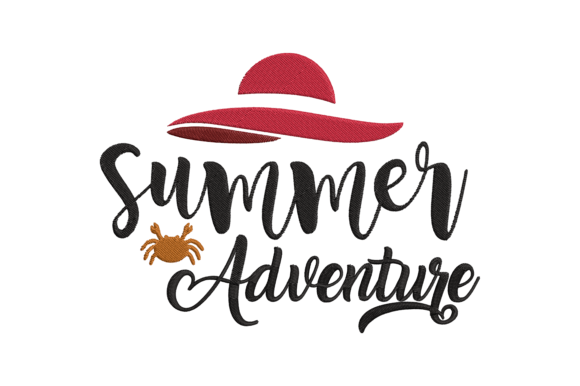
Summer Adventure Embroidery Design
First Impression: Elegant Charm Meets Seasonal Joy
As an embroidery designer who’s prepped over 200 craft fair booths—and shipped thousands of embroidered tote bags, tea towels, and patches—I opened Summer Adventure expecting something cheerful. What I found was more refined than expected: a design that balances lightness and intention. The title alone signals warmth, movement, and possibility—no cliché suns or palm trees required. From the description—“elevate any fabric… elegance and charm… unique and eye-catching”—I read intentionality, not just decoration. This isn’t a loud festival motif; it’s a soft-spoken summer statement. Think cottagecore meets modern handmade: gentle curves, balanced negative space, and a quiet confidence that reads as premium—not precious.
Where Summer Adventure Shines in Real Booth Displays
In my booth setup last June, customers paused longest at three things: embroidered aprons with botanical accents, linen tea towel sets with subtle corner motifs, and structured canvas tote bags featuring centered, medium-scale designs. Summer Adventure fits all three—but excels most on tote bag design and apron embroidery. Its composition allows breathing room at scale (10–12 inches wide), yet holds clarity when scaled down to 3–4 inches for patches or pouches. On a natural canvas tote, it reads as intentional craftsmanship—not filler. On a lightweight linen apron, it feels like a signature, not an afterthought.
Tea towel embroidery is trickier: textured terry or heavy cotton can swallow fine details. But if Summer Adventure avoids tight clusters or ultra-thin stems, it’ll translate beautifully onto medium-weight flour-sack towels—especially when stitched with matte cotton thread for tactile softness. As an embroidered patch, it’s highly adaptable: iron-on or sew-on, it adds instant character to denim jackets or market bags without overwhelming.
What Makes It Sell—And What Requires Caution
Summer Adventure works because it’s instantly legible at 6 feet—the critical distance for craft fair browsing. Customers don’t need to lean in or squint. That means strong performance as a booth sample and high click-through on Etsy listings where thumbnail clarity drives discovery. It also photographs well across lighting conditions—no harsh shadows or stitch bleed—making printable mockups reliable for social posts and digital listings.
But caution is essential. If the design includes tiny lettering, dense fill areas, or delicate linework under 1.5mm, those elements risk disappearing on dark fabric or textured surfaces like waffle-weave towels. Curved cap surfaces demand simplified outlines—so test Summer Adventure on a baseball cap mockup before committing to a batch. Likewise, thick stabilizer may be needed for commercial embroidery on fleece-lined pouches or quilted pillow covers. Always verify stitch density: too dense = puckering; too sparse = fragile edges.
Production Realities Every Handmade Seller Should Know
This isn’t just about aesthetics—it’s about throughput and consistency. For small shop owners juggling orders, Summer Adventure must be repeatable. That means predictable hoop size (check your machine’s max before digitizing), consistent thread color transitions (avoid more than 5–6 colors unless you’re hand-threading), and minimal jump stitches. If the embroidery file requires frequent re-hooping or complex layering, it slows production and raises error rates—especially during craft fair prep crunch time.
I always run these checks before cutting fabric:
- Test the design on scrap fabric matching your final product’s weight and texture
- Confirm thread contrast—especially on light pastels or navy bases
- Review spacing between elements: tight clusters trap lint and fray faster
- Verify hoop size compatibility with your smallest and largest intended products
- Inspect stitch density visually—zoom in on fills and satin borders
- Use cutaway stabilizer for stretchy or unstable fabrics; tear-away for stable linens
- Create at least one real-world mockup—not just a digital preview
- Compare how it reads on off-white vs. charcoal fabric swatches
- Confirm commercial licensing status before selling finished products
Why Summer Adventure Strengthens Your Brand—Not Just Your Booth
Customers don’t buy embroidery—they buy meaning, mood, and maker trust. Summer Adventure supports brand consistency because it’s versatile but never generic. It feels cohesive across a line: same design on a linen pillow cover, a cotton market bag, and a recycled-canvas pouch tells a unified story—handmade, seasonal, quietly confident. That cohesion builds recognition, especially for Etsy sellers and boutique makers curating collections around themes like “slow summer” or “backyard living.”
It also elevates perceived value. A plain tote bag sells for $28. Add Summer Adventure with clean stitching and thoughtful placement? $42—with no markup justification needed. Buyers see the care in the balance, the precision in the curve, the restraint in the detail. That’s what makes it a craft fair product that converts browsers into repeat buyers.
Final Designer Notes Before You Stitch
Before you load the digital embroidery file, ask: Does this feel like a design you’d proudly hang in your own kitchen? Does it hold up when printed at 2x2 inches for a patch listing? Does it avoid over-engineering—no unnecessary gradients, micro-details, or thread-trap corners?
Remember: your customer touches the fabric first, sees the texture second, and only then reads the story. Summer Adventure succeeds when it feels intentional in hand—not just on screen. So stitch slow on the first run. Check tension. Feel the backside for stiffness or looseness. Then step back and ask: does this make someone pause, smile, and reach out? If yes—you’ve got a keeper.
For handmade product sellers, small shop product creators, and commercial embroidery operators alike: Summer Adventure isn’t just another summer-themed machine embroidery design. It’s a quiet differentiator—one that earns attention without shouting, adds value without overcomplicating, and stays true to the handmade ethos: skill, season, and soul.