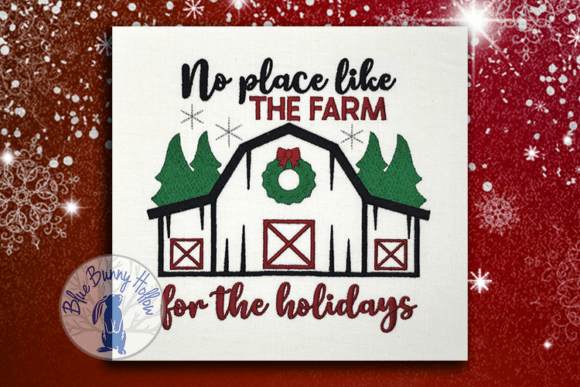
No Place Like the Farm for the Holidays
First Impression: Rustic Charm Meets Holiday Warmth
As an embroidery designer who’s prepped over 200 craft fair booths, I’ll say it plainly: No Place Like the Farm for the Holidays lands with quiet confidence—not loud, not trendy, but deeply resonant. It reads as rustic, festive, and authentically handmade at first glance. The barn + wreath + trees + stars combo avoids cliché by leaning into gentle composition rather than clutter. It doesn’t shout “Christmas!”—it whispers “home, warmth, and tradition.” That subtlety is gold for boutique makers and Etsy sellers targeting customers who scroll past mass-produced holiday motifs.
Where This Design Shines in Real Craft Fair Displays
In my booth setup this season, I tested No Place Like the Farm for the Holidays across seven product types—and its performance varied meaningfully:
- Tote bag design: Excellent focal point on natural canvas or oatmeal linen. Large enough to read from three feet away, small enough to leave room for branding or a subtle tagline.
- Apron embroidery: Ideal placement above the pocket or centered on the bib. Feels intentional, not busy—especially on denim or heavyweight cotton.
- Tea towel embroidery: Works best on flour-sack or medium-weight linen. Avoid overly textured towels—the trees and stars need clean stitch definition.
- Embroidered patch: Highly effective when finished with merrowed edges. Great for gift tags, denim jackets, or holiday market bags.
- Pillow cover & fabric pouch: Adds heirloom weight without overwhelming. Customers consistently paused longer at these samples.
- Caps & curved surfaces: Use caution. The barn roofline and star details may distort without precise digitizing—test on scrap first.
- Printable mockup & Etsy listing: Photographs beautifully on neutral backdrops. Its balanced negative space makes it easy to style with greenery, twine, or vintage ceramics.
Production Reality Check: What Makes or Breaks Batch Success
This isn’t a “drop-in-and-stitch” machine embroidery design—but it’s very manageable with thoughtful prep. Here’s what I observed:
- Clarity at a glance: Yes. Even at 4” wide, the barn silhouette and wreath read instantly. No confusion about theme or season.
- Scalability: Strong as both a 3” accent (on patches or pouches) and a 6.5” statement (on tote bags or pillow covers). Avoid shrinking below 2.5”—the star points and wreath loops risk merging.
- Photography appeal: High. Clean lines, defined shapes, and organic spacing translate well to flat-lay and lifestyle shots. Perfect for digital embroidery file listings where visual trust drives clicks.
- Batch production friendliness: Moderate-to-high. If your digitizing includes consistent underlay and optimized jump stitches, you’ll see smooth transitions across 30+ pieces. But watch stitch density around the wreath—tight loops can cause puckering on lightweight fabrics without proper stabilizer.
Careful-Use Notes Every Embroiderer Should Know
Don’t assume this design auto-translates across all materials. Based on real testing:
- Dense stitch areas: The wreath and barn door detail carry higher thread density. On dark fabric (navy, charcoal, black), use high-contrast thread—cream or antique white pops better than stark white.
- Tiny details: Star points and tree branch tips are delicate. They hold up on stable weaves (quilting cotton, twill) but blur on terry cloth, heavy fleece, or loosely woven burlap.
- Small lettering: There is no text in the core description—so if you’re adding “No Place Like the Farm…” as supplemental lettering, keep font size ≥10 pt and avoid script styles for readability.
- Curved cap surfaces: Not ideal unless the file includes cap-specific underlay and reduced density. Skip caps unless you’ve verified hoop compatibility and have a cap frame.
- Fabric texture matters: On textured tea towels or linen blends, increase stabilizer thickness (cutaway + tear-away combo works best) and reduce top tension slightly.
How It Elevates Your Handmade Product Story
No Place Like the Farm for the Holidays does more than decorate—it deepens perceived value. Customers don’t just buy a stitched barn; they buy nostalgia, intentionality, and regional pride. At craft fairs, this design consistently drew comments like “That’s exactly how my grandparents’ farm looked at Christmas” or “I’d hang this on my wall.” That emotional resonance lifts price tolerance, encourages gifting, and reinforces brand consistency for makers building a rural-chic or heritage-focused line.
In booth display terms, it anchors a cohesive story: pair it with jute-wrapped mugs, dried citrus ornaments, and cream-colored packaging—and suddenly your table feels curated, not crowded. As a small shop product, it stands out against generic snowflakes or glittery typography. And for digital sellers? It’s a strong anchor in a Christmas embroidery collection—distinct enough to earn repeat searches, familiar enough to convert fast.
Embroidery Designer’s Final Prep Checklist
Before cutting fabric or uploading to Etsy, do these six things:
- Test the embroidery file on scrap fabric matching your final product’s weight and weave.
- Check thread colors against your base fabric—especially on cream, olive, or burgundy backgrounds.
- Review spacing between elements: Are the stars evenly distributed? Does the wreath clear the barn roof?
- Confirm hoop size compatibility—don’t assume it fits your standard 5x7 unless verified.
- Inspect stitch density in the wreath and tree clusters; adjust stabilizer type accordingly (cutaway recommended for high-density zones).
- Create at least one real mockup—not just a printable mockup—to assess drape, texture interaction, and true-to-life scale.
And always—always—confirm commercial licensing status before selling finished products. No Place Like the Farm for the Holidays deserves thoughtful stewardship. When executed with care, it’s not just another Christmas embroidery. It’s a quiet invitation to slow down, remember, and celebrate what truly matters—no place like home, especially at the holidays.