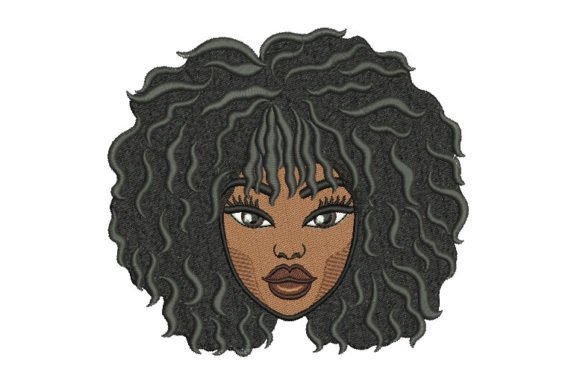
African Woman with Curly Hair
First Impression: Warm, Authentic, and Visually Anchoring
As an embroidery designer who’s digitized over 2,000 commercial designs for small businesses, my first read on African Woman with Curly Hair is immediate and positive: it reads as warm, confident, and culturally grounded—not decorative filler, but a statement with quiet authority. The phrase “a cute African girl will not leave anyone indifferent” signals approachability and emotional resonance, which is gold for brand identity. In the Beauty category, this design avoids cliché by centering natural texture, facial expression, and proportion—qualities that translate beautifully into stitched form when digitized thoughtfully. It feels modern without trend-chasing, handmade without looking amateurish, and inclusive without being generic.
Where It Shines in Small Business Merch
African Woman with Curly Hair excels where personality meets practicality. For a local café or florist launching branded aprons, this design works powerfully at 3–4 inches wide on the chest—its curly hair provides natural stitch movement, softening rigid outlines and adding dimension to cotton twill. On staff caps, placed front-and-center, the portrait’s strong silhouette holds up even at 2.25 inches, especially when paired with clean thread colors like deep cocoa, burnt sienna, or navy. As an embroidered patch sewn onto tote bags or denim jackets, it becomes a signature touch—ideal for boutiques, bakeries, or pet brands wanting to signal care, individuality, and community connection.
For Etsy sellers and handmade brands, African Woman with Curly Hair strengthens visual consistency across product lines: use it as a sleeve detail on work shirts, a subtle label accent on product packaging (think linen tea bags or ceramic soap wraps), or a limited-edition event merch motif. Its human-centered focus builds trust faster than abstract logos—customers recognize intentionality, not just decoration. When used alongside complementary design assets (e.g., minimalist typography or botanical line art), it elevates perceived product value without sacrificing authenticity.
Real-World Considerations for Commercial Embroidery
That said, African Woman with Curly Hair demands thoughtful execution—not because it’s flawed, but because its expressive detail requires respect for scale and surface. On curved cap fronts or tapered tote bag handles, test placement early: avoid stretching the face or compressing curls, which can distort recognition. At under 2 inches tall, fine features (eyelashes, lip definition, curl separation) may collapse unless the original machine embroidery design was optimized for small patch size. Always request the digital embroidery file specs before ordering: confirm if it includes multiple sizes, what hoop size it’s built for, and whether stitch density stays balanced across hair texture and skin tone areas.
Dark uniforms? Use high-contrast thread colors—ivory, pale gold, or soft peach against charcoal or forest green—rather than relying on white alone, which can gray after repeated washing. On textured fabric like burlap, linen, or looped terry, add medium-weight cutaway stabilizer beneath the design to prevent puckering around delicate facial contours. And never skip the fabric test: run a sample on your exact garment material before bulk production. What looks crisp on polyester poplin may blur on slubbed organic cotton.
Smart Workflow Notes Every Embroidery Shop Should Follow
- Start monochrome: Stitch a black-and-white version first to assess clarity, spacing, and balance—color can mask structural weaknesses.
- Validate scale: Resize the embroidery file to your target dimensions and check if curls retain shape and eyes remain readable.
- Review thread color contrast: Skin tones and hair gradients must stand out clearly against both light and dark base fabrics.
- Inspect spacing: Ensure no elements bleed into adjacent text or logos if used in combination layouts.
- Confirm hoop compatibility: If using multi-position hoops or automated frames, verify the design fits within standard 4x4", 5x7", or larger footprints.
- Create a printable mockup: Present stitched visuals on real product photos—not flat PNGs—to clients for confident approval.
- Compare beside existing assets: Does African Woman with Curly Hair harmonize with your current logo, palette, or typography—or does it require subtle tweaks?
- Verify licensing: Confirm commercial use rights before applying to paid merchandise, wholesale apparel, or resale patches.
Strengthening Brand Identity Through Intentional Embroidery
Small business owners often underestimate how much a single embroidered motif shapes perception. African Woman with Curly Hair doesn’t just “decorate”—it communicates values: representation, craftsmanship, warmth, and attention to human detail. When stitched onto a barista’s apron, it says “we see you.” On a florist’s tote, it whispers “thoughtfully made.” That kind of resonance increases customer engagement, repeat visits, and social shares—especially among audiences seeking authenticity over polish.
Crucially, this design supports long-term brand flexibility. Unlike seasonal graphics or slogan-based embroidery, African Woman with Curly Hair avoids dated trends. It adapts across mediums: scaled down for a woven label, enlarged for a wall banner, simplified for a heat-transfer variant. And because it lives in the Embroidery category—not clipart or vector—it inherently signals tactile quality, reinforcing the handmade product experience customers pay a premium for.
Final Thought: A Design That Works Harder Than It Looks
African Woman with Curly Hair is more than a portrait—it’s a versatile, emotionally intelligent tool for small business merch. It performs across caps, aprons, totes, patches, and packaging when approached with technical care and brand-aligned intent. For embroidery shops, it’s a conversation starter with clients about storytelling through stitch. For Etsy sellers, it’s a differentiator in saturated markets. For cafés, studios, and boutiques, it’s a quiet yet powerful way to say, “This space honors real people.” Just remember: every great custom apparel project begins not with the design alone—but with how well you prepare it for the real world.